Beyond the Diploma: Building a Lifelong Learning and Skills Ecosystem
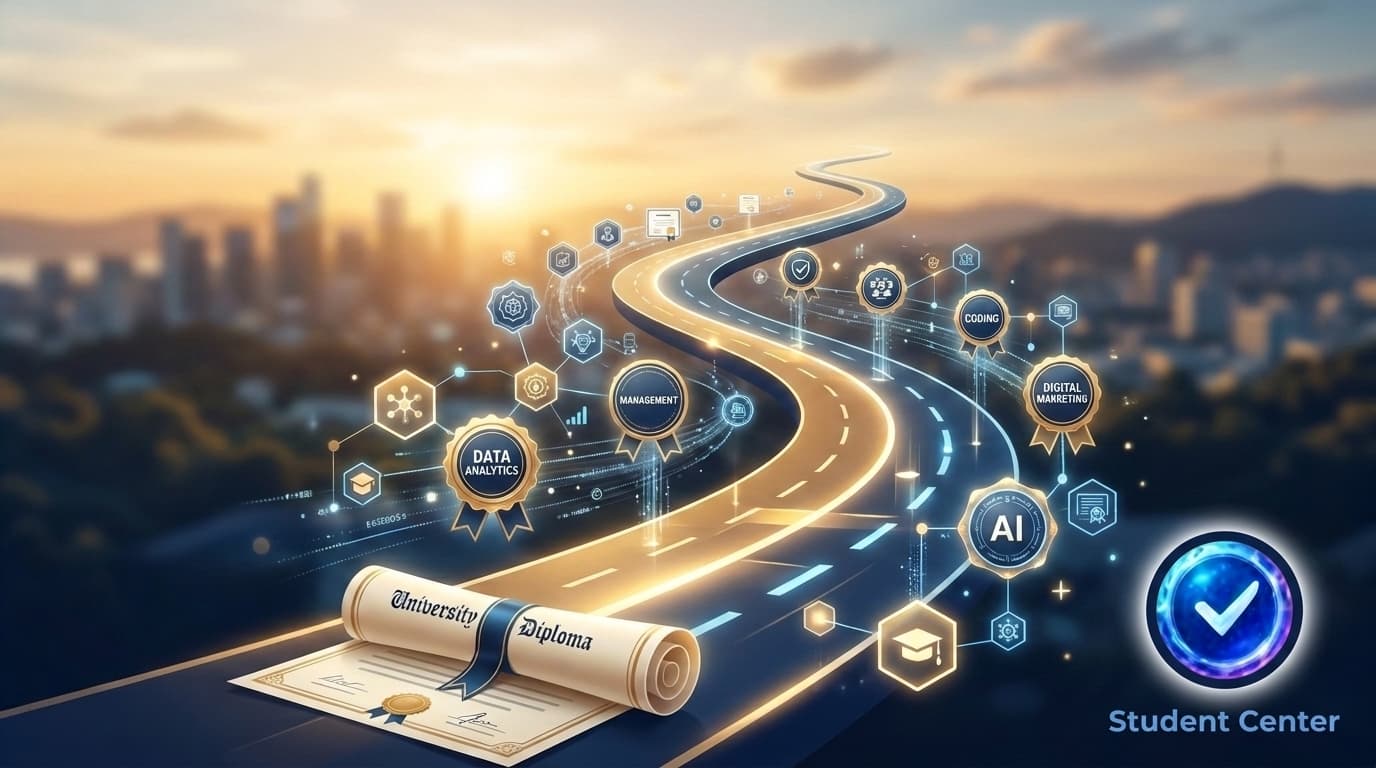
A student graduates from university with a degree, a transcript, and years of accumulated knowledge.
Then something interesting happens.
The student enters a professional world where learning never really stops.
They complete industry certifications, attend workshops, acquire technical skills, participate in specialized training, and gain experience with technologies that may not have existed during their formal education.
Over time, their professional capabilities expand significantly.
But where does the evidence of all that learning live?
Some achievements appear on a résumé. Others exist as PDF certificates, digital badges, course completion emails, or records inside separate learning platforms.
The individual's actual knowledge and capabilities continue to grow, while the record of those achievements becomes increasingly fragmented.
What if learning, credentials, skills, and professional opportunities could become part of a more connected experience?
That question is central to the vision behind Student Center.
The Problem: Education Is Fragmented
Today's learners often navigate a collection of disconnected systems.
A university manages formal academic records. A learning management system tracks courses. Professional organizations issue certifications. Online education platforms maintain completion histories. Employers operate separate training systems. Career platforms provide another place to list qualifications and experience.
Each system serves a purpose. But the learner is left to connect the pieces.
This fragmentation creates challenges for students, graduates, educators, and employers.
Learners may struggle to organize and communicate their achievements. Institutions may have limited visibility into the learning their graduates pursue after leaving campus. Employers may find it difficult to evaluate qualifications earned across multiple providers. And valuable learning experiences may receive less recognition than they deserve.
The opportunity is not necessarily to replace these systems. It is to create better connections between them.
Learning Paths Can Make Education More Navigable
One way to improve the experience is through structured learning paths.
Instead of treating every course as an isolated activity, a learning path organizes related educational experiences around a defined goal.
Consider a learner interested in artificial intelligence.
A foundational path might introduce AI concepts, responsible use, prompt design, and common professional applications. An intermediate path could introduce workflow automation, data handling, and practical implementation. An advanced path might focus on building AI-powered applications, integrating tools, and evaluating intelligent systems.
Each stage builds upon the previous one. The learner can see where they are, what they have accomplished, and what skills they may want to develop next.
Similar pathways could support blockchain, digital finance, cybersecurity, data analytics, entrepreneurship, and other emerging disciplines.
The objective is to make learning more intentional and easier to navigate.
Recognizing More Than Traditional Academic Milestones
A university degree represents a significant educational achievement.
But many valuable skills are developed outside traditional degree requirements.
Students participate in hackathons, research projects, internships, technical workshops, industry competitions, and professional development programs. These experiences may demonstrate initiative, collaboration, problem-solving, and applied technical knowledge. Yet they are not always represented clearly in formal academic records.
Digital badges and microcredentials can help institutions recognize more specific accomplishments.
A badge might acknowledge completion of a learning module, participation in a project, or demonstration of a particular competency. A more advanced credential might require a formal assessment or verified practical achievement.
These distinctions matter. Not every learning experience should carry the same level of recognition, and a trustworthy credentialing system should make the requirements behind each achievement clear.
Why Verifiable Credentials Matter
As educational achievements become more diverse, the ability to verify them becomes increasingly important.
A credential should answer basic questions:
- Who issued it?
- What achievement does it represent?
- When was it earned?
- What criteria were required?
- Can its authenticity be verified?
Modern digital credentialing technologies can make this information easier to organize and share.
Blockchain-based credentials introduce additional possibilities for maintaining verifiable records without depending exclusively on a single institution's internal database.
However, blockchain is an infrastructure choice, not a substitute for educational quality. A credential is only as meaningful as the achievement it represents and the organization standing behind it.
At Student Center, we view verifiable credentials as one part of a broader effort to make educational accomplishments more useful throughout a learner's life.
A Real-World Example: Professional Blockchain Education
MM Blockchain Academy (MMBA) provides an example of how professional education and on-chain credentialing can intersect.
MMBA offers specialized education and certifications for professionals working with blockchain and digital assets. Through Student Center, eligible certification achievements can be represented by blockchain-minted credentials.
For learners, the technology becomes more than a subject discussed in a course. It becomes part of the educational experience itself.
Certified Blockchain Accounting Professional (CBAP™) graduate Cassandra Grace Catuday, CPA, MBA, described having her credential minted on the blockchain as a highlight because it brought the concepts she studied to life.
Her experience illustrates an important principle: the technologies students learn about can also help shape how their achievements are recognized.
It also demonstrates why education providers and credentialing platforms can be valuable partners. The education provider delivers the curriculum, instruction, and assessment. The credentialing infrastructure helps represent and verify the resulting achievement. Together, they can create a more connected learning experience.
Universities Have an Opportunity to Extend Their Relationship With Learners
Graduation should represent an important milestone, not the end of the educational relationship.
Universities already have alumni communities, professional networks, continuing education programs, and relationships with employers. A more connected learning ecosystem could help institutions bring these resources together.
Imagine a graduate who returns to their university's digital learning environment to complete an emerging technology course. They earn a credential recognizing the new achievement. Later, they complete another specialized program and add another verified accomplishment.
Over time, they build a record of learning that reflects both their academic foundation and their continuing professional development.
For institutions, this creates opportunities to support alumni engagement, professional education, and lifelong learning. For learners, it offers a more coherent way to build and demonstrate evolving capabilities.
Connecting Skills With Professional Opportunity
Credentials should not exist simply to accumulate. Their greatest value emerges when they help learners communicate what they know and what they can do.
A well-designed learning ecosystem can connect educational achievements with professional identity and career development — allowing learners to share verified credentials, organize skill portfolios, explore relevant learning opportunities, and discover career pathways aligned with their interests.
The Student Center Vision
Student Center is being developed to help address several connected challenges in education:
- Access to relevant learning. Learners need opportunities to develop skills in technologies and disciplines that continue to evolve.
- Recognition of achievement. Valuable educational experiences deserve meaningful, trustworthy recognition.
- Portable professional identity. Learners should have better ways to organize and communicate accomplishments earned across different stages of life.
- Connections to opportunity. Educational achievements should be easier to translate into professional development and career exploration.
- Institutional continuity. Universities and educational organizations should have more ways to support learners after an individual course or degree program ends.
We believe these challenges are connected.
A credential without meaningful learning has limited value. Learning without recognition can be difficult to communicate. Recognition without pathways to continued growth may become another isolated record. And educational achievement without connections to real-world opportunity leaves part of its potential unrealized.
Our vision is to bring these pieces closer together.
Building the Next Chapter of Education
Education is entering a period of significant change.
Artificial intelligence is reshaping professional skills. New technologies are creating new learning requirements. Traditional institutions are exploring more flexible programs, and individuals are increasingly responsible for continuing their education throughout their careers.
No single platform can solve every challenge facing education. But better infrastructure can help institutions and learners respond.
Student Center is building toward an environment where learning is more connected, achievements are more portable, and professional development becomes a continuous journey.
We see digital credentials as an important starting point. The larger opportunity is helping people learn, grow, demonstrate their capabilities, and discover what comes next.
Because the future of education is not just about what you earn at graduation. It's about everything you continue to learn afterward.
Student Center is developing a connected ecosystem for emerging technology education, digital credentials, learning pathways, and professional opportunity.
